August 27, 2026
Guide to Multi-Agent AI Systems
Ready to scale your automation? Learn how to coordinate multi-agent AI systems and design high-fidelity workflows with specialized autonomous AI teams.
Orchestrating the Machine: A Master Guide to Coordinating Multi-Agent AI Systems for Complex Enterprise Workflows
The single-prompt era is drawing to a close. While early AI adoption focused on perfecting individual prompts to extract complete solutions from a single Large Language Model (LLM), enterprises are quickly discovering that this approach has a hard ceiling. Complex business processes are rarely linear or solitary. They require a division of labor, peer review, specialized knowledge, and rigorous validation.
This is where the shift toward multi-agent AI systems comes in. Instead of forcing one model to act as researcher, writer, analyst, and editor simultaneously, forward-thinking organizations are building networks of specialized, autonomous AI teams. By assigning distinct roles, memory structures, and communication protocols to separate agents, businesses can automate complex, multi-step workflows with unprecedented accuracy and resilience.
This comprehensive guide explores the structural mechanics of AI agent orchestration, details how to build and condition specialized AI teams, and outlines the practical blueprints necessary to deploy high-fidelity multi-agent workflow design in your business.
The Architecture of the Multi-Agent Shift
To understand why multi-agent systems are transforming enterprise automation, we must first look at the mathematical limits of single-model prompting. LLMs operate by predicting the next most probable token. When you ask a single model to digest 50 pages of documentation, write a technical proposal, format it for a C-suite presentation, and run a compliance check, you dilute its attention.
The model's internal attention mechanism must balance wildly different instructions, style guidelines, and factual guardrails simultaneously. This dilution dramatically increases the probability of hallucinations, omissions, and logical inconsistencies.
Multi-agent AI systems solve this by decomposing a macro-objective into highly focused micro-tasks. Each agent operates within a restricted scope, leveraging targeted prompt conditioning, specialized tools, and isolated context windows.
Single-Agent vs. Multi-Agent Workflows
The operational difference between these two paradigms is stark. The table below illustrates how dividing labor among specialized agents improves enterprise performance across critical operational vectors:
| Operational Vector | Single-Agent Approach | Multi-Agent AI Systems |
|---|---|---|
| Context Window Management | High bloat; a single prompt must hold all instructions, system rules, and database schemas. | High efficiency; individual agents only process domain-specific context and tools. |
| Task Complexity | Restricted to linear, single-turn generations or basic script execution. | Capable of multi-step reasoning, iterative critique, and dynamic tool usage. |
| Error Propagation | High; a minor hallucination early in the output cascades through the rest of the generation. | Low; downstream validator agents act as localized quality gates to catch errors early. |
| System Scalability | Rigid; any change to the workflow requires re-engineering the entire monolithic prompt. | Modular; individual agents can be updated, swapped, or retrained without breaking the pipeline. |
Conditioning the Mind of the Agent: Persona & Focus
In a multi-agent system, an agent is more than just a prompt; it is a system container combining an LLM, a specific persona, a set of tools (like APIs, search engines, or code execution environments), and a memory bus.
To coordinate autonomous AI teams effectively, you must understand how system prompts shape the attention of these models. A system prompt does not just tell the model what to do; it shifts the probability distribution of its weights, conditioning it to act as a highly specific filter.
For instance, to build a three-agent research and reporting team, you must define distinct behavioral boundaries:
Key Insight: Persona conditioning works because it constrains the search space of the model's attention. A "Compliance Auditor" agent will look for data privacy violations that a "Creative Copywriter" agent is mathematically conditioned to ignore.
1. The Researcher Agent
- System Conditioning: "You are an analytical researcher. Your sole objective is to extract verifiable, source-backed facts from the provided documents. You prioritize citation accuracy above narrative flow. Do not synthesize opinions; only extract structured evidence."
- Allowed Tools: Vector Database Query Engine, Google Search API, PDF Parser.
2. The Writer Agent
- System Conditioning: "You are an expert technical writer. Your goal is to transform structured raw data into engaging, professional narratives. You must not invent facts; you must rely strictly on the structured briefs provided by the Researcher Agent."
- Allowed Tools: Internal style guide database, markdown formatting engines.
3. The Compliance Agent
- System Conditioning: "You are a regulatory compliance auditor. Your job is to aggressively critique draft documents for security risks, regulatory violations, and brand-voice misalignment. You do not write new content; you only provide structured critique and pass/fail flags."
- Allowed Tools: Regex classifiers, PII (Personally Identifiable Information) scanners, policy documentation indexes.
Orchestration Patterns: How AI Agents Collaborate
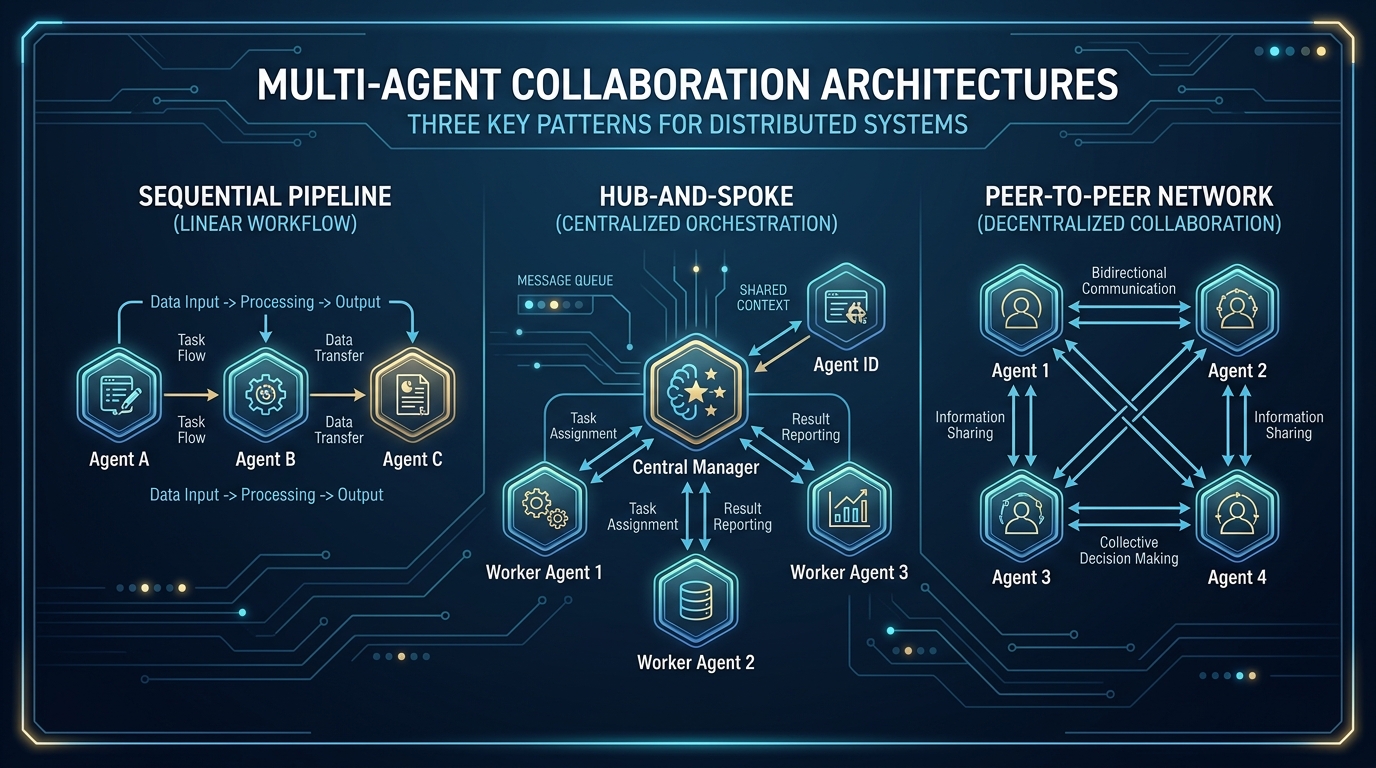
Once you have built your specialized agents, you must design how they talk to one another. AI coordination frameworks generally rely on three primary topological patterns. Selecting the right pattern depends entirely on the complexity and predictability of the business process.
Pattern A: The Sequential Pipeline (Linear Routing)
In a sequential workflow, the output of Agent A serves as the direct input for Agent B, which then feeds into Agent C. This is ideal for straightforward, highly predictable processes such as software compilation, language translation pipelines, or simple content generation loops.
- Example: Researcher gathers data -> Writer writes draft -> Translator translates draft.
- Pros: Extremely simple to build, debug, and monitor.
- Cons: Highly rigid. If Agent A makes a mistake, the error cascades downstream without any mechanism for backtracking.
Pattern B: The Hierarchical Network (Hub-and-Spoke)
In this pattern, a centralized "Manager Agent" or "Router" coordinates a team of specialized workers. The user interacts only with the Manager. The Manager breaks down the query, assigns sub-tasks to the appropriate worker agents, collects their outputs, resolves conflicts, and delivers the final synthesis.
- Example: A user asks to write a market analysis report. The Manager Agent asks the Web Scraper Agent for data, sends that data to the Analyst Agent, directs the Chart Generator Agent to create visual assets, and passes everything to the Editor Agent.
- Pros: Highly flexible. The system can handle dynamic, unpredictable user queries.
- Cons: The Manager Agent becomes a single point of failure and context-window bottleneck.
Pattern C: Peer-to-Peer (Collaborative Consensus)
In peer-to-peer networks, agents communicate freely with one another using shared memory spaces or message brokers. They can debate, request peer reviews, and collaboratively solve a problem without a centralized coordinator.
- Example: A software engineer agent and a code reviewer agent run an iterative loop: writing, testing, critiquing, and rewriting code until a specific suite of unit tests passes.
- Pros: Excellent for creative problem-solving, code generation, and deep reasoning tasks.
- Cons: Risk of infinite loops, high token consumption, and unpredictable runtime execution.
Step-by-Step Blueprint to Designing a Multi-Agent System
To transition from theory to execution, let us map out the implementation of a high-performance multi-agent workflow design for an enterprise market intelligence team. This blueprint focuses on turning raw regulatory filings into highly polished, secure, and compliant market briefs.
Step 1: Mapping the State Machine and Memory Bus
Before writing a single line of code or system prompt, you must design the state of your workflow. What data needs to persist across the entire operation?
Rather than passing massive chat histories back and forth between every agent (which rapidly depletes context windows and inflates API costs), implement a centralized State Memory Bus.
[Centralized State Store]
  ├── Document Metadata (Source PDF, Date, Author)
  ├── Extracted Financial Metrics (Key-Value JSON)
  ├── Draft Narrative (String Markdown)
  └── Compliance Audit Log (List of Violations)
Each agent is granted read/write access only to the specific keys within this State Store that are relevant to its role.
Step 2: Designing Communication and Hand-off Protocols
You must define the exact trigger conditions that signal when an agent has completed its task and which agent should take over next.
For example, using a state-machine framework like LangGraph or CrewAI, you can define conditional routing based on structured JSON outputs. Below is a conceptual logic routing sequence for our workflow:
# Conceptual execution flow within the Orchestrator
if state["research_complete"] is False:
    route_to("Financial_Researcher_Agent")
elif state["draft_written"] is False:
    route_to("Narrative_Writer_Agent")
elif state["compliance_verified"] is False:
    route_to("Compliance_Auditor_Agent")
else:
    route_to("Human_In_The_Loop_Review")
Step 3: Implementing Tool Sandboxing and Security Guardrails
Agents require tools to interface with the physical world. However, giving autonomous entities access to code execution environments, internal databases, or external APIs introduces substantial security liabilities.
To mitigate these risks, enforce three architectural guardrails:
- Strict Sandboxing: Run any code-execution or file-parsing tool in ephemeral, isolated Docker containers or serverless micro-VMs.
- Read-Only Database Access: Ensure that vector retrievers and relational database tools use read-only database connections with row-level security enabled.
- Output Boundary Validation: Before an agent writes data back to your core enterprise databases, run structured verification schemas (such as Pydantic models) to prevent database injection attacks or corrupted data writes.
Choosing Your Multi-Agent Orchestration Framework
Building multi-agent systems from scratch using raw API calls is highly complex. Fortunately, the open-source and enterprise ecosystem has matured rapidly, offering robust frameworks designed specifically for AI agent orchestration.
To help you choose the right foundation for your project, consider the strengths of these three leading frameworks:
- LangGraph (by LangChain):
- Best For: State-heavy, complex cyclic graphs where agents need to loop back and forth dynamically based on logic.
- Key Strength: Exceptional control over state transitions, memory, and multi-agent coordination.
- CrewAI:
- Best For: Role-playing workflows where human-like collaboration, delegation, and sequential task management are required.
- Key Strength: Highly intuitive setup with built-in patterns for task delegation and role definition.
- Microsoft AutoGen:
- Best For: Highly conversational, peer-to-peer agent communities capable of complex, collaborative code generation.
- Key Strength: Native support for multi-agent conversations, code execution environments, and complex group chats.
Keeping Humans in the Loop (HITL)
While autonomous AI teams can dramatically accelerate operational output, they must not run completely unsupervised in enterprise environments. The goal of multi-agent design is not to eliminate human oversight, but to elevate humans from creators to curators.
By placing strategic Human-in-the-Loop checkpoints at critical hand-off states, you ensure absolute alignment with organizational standards. For instance, in our market intelligence blueprint, the system should halt execution and wait for human approval immediately after the Compliance Auditor Agent signs off, but before the brief is published to clients.
This structural checkpoint acts as a crucial firewall. It gives your domain experts a clean interface to inspect the centralized State Store, review the critique history of the agents, and authorize the final release with confidence.
Related Reading
To learn more about optimizing your team's AI transition, securing your data pipelines, and building robust enterprise automation structures, explore our in-depth guides:
Enjoyed this article? Join the Growency newsletter
Practical AI tips for service businesses, straight to your inbox. No spam, unsubscribe anytime.