August 31, 2026
RAG vs Fine-Tuning: How to Customize Enterprise LLMs
Compare RAG vs fine tuning for enterprise LLM customization. Use our actionable decision framework to choose the right strategy, lower costs, and scale AI.
RAG vs Fine-Tuning: The Decision Framework for Customizing Enterprise LLMs
As enterprises transition generative AI from experimental pilots to core production workflows, the challenge of customization becomes paramount. Out of the box, foundation models are generalists. They lack the proprietary data, internal product knowledge, and specialized terminology required to execute high-fidelity business operations.
To bridge this gap, technology leaders face a critical architectural decision: do they implement Retrieval-Augmented Generation (RAG) or invest in Fine-Tuning?
Choosing the wrong path can lead to millions of dollars in wasted compute, severe latency bottlenecks, or costly hallucinations in production. This guide delivers an authoritative, actionable decision framework to help enterprise architects, CTOs, and product leaders select, execute, and scale the right LLM customization strategy.
Understanding the Core Paradigms: What is RAG vs Fine-Tuning?
Before comparing these two approaches, we must define how they alter model behavior and where they sit in the modern enterprise AI stack.
Retrieval-Augmented Generation (RAG)
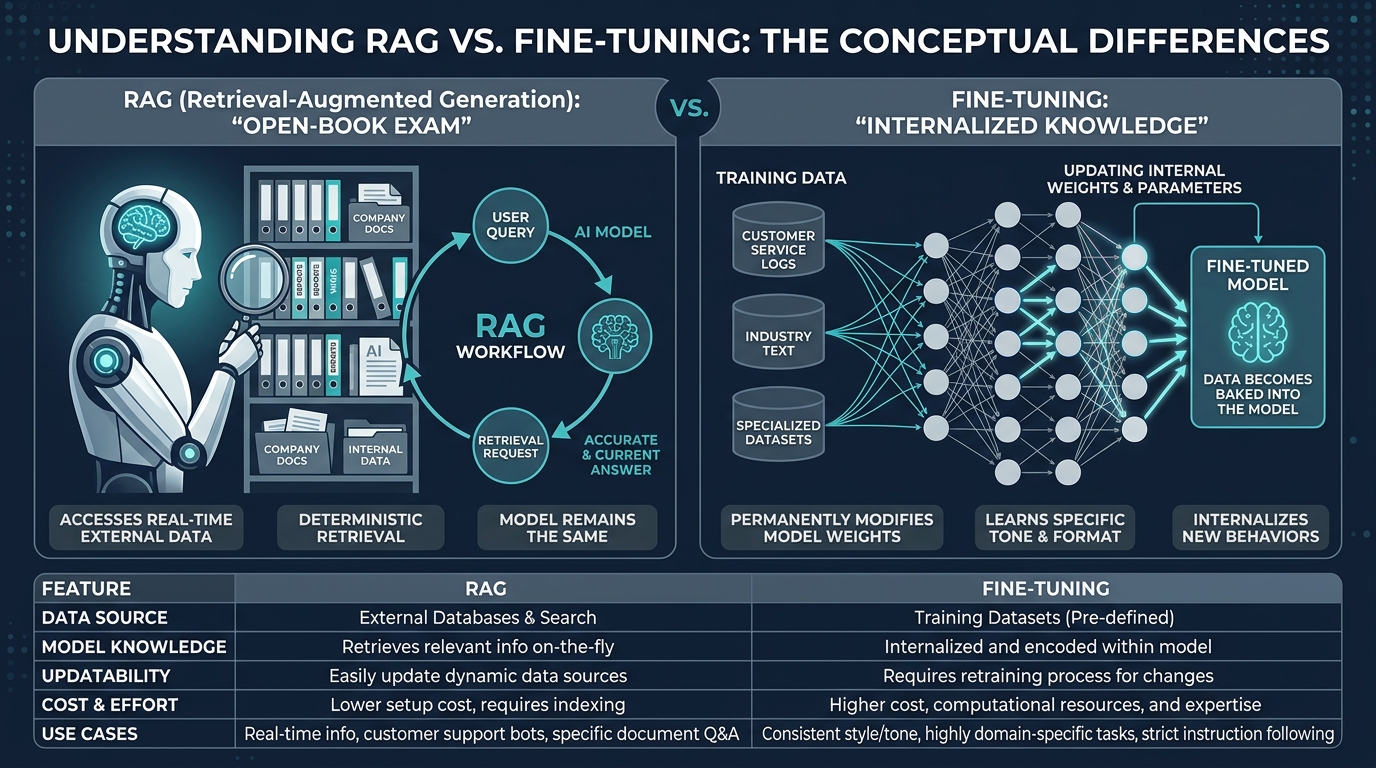
Retrieval-Augmented Generation is an architectural pattern that dynamic-links an LLM to external data sources. When a user submits a query, a retrieval system (typically powered by a vector database) searches your company's knowledge bases, pulls the most relevant documents, and appends them to the user's prompt as context. The LLM then synthesizes this real-time context to generate a precise, grounded response.
Think of RAG as giving the model an open-book exam. The model does not need to memorize your company policies; it simply needs to know how to read, analyze, and summarize the documents placed in front of it.
Fine-Tuning LLMs
Fine-tuning is the process of taking an existing foundation model and training it further on a curated dataset. This process updates the actual weights and parameters of the neural network. Through fine-tuning, the model internalizes specific formatting rules, structural patterns, domain-specific vocabularies, and stylistic nuances.
Think of fine-tuning as sending the model to specialized graduate school. It internalizes the behavior, tone, and foundational knowledge structure so that it can perform highly specific tasks natively, without needing external instructions for every query.
Key Insight: RAG changes what the model knows by injecting real-time information into the context window. Fine-Tuning changes how the model behaves by permanently altering its internal neural pathways.
The Dimension-by-Dimension Comparison
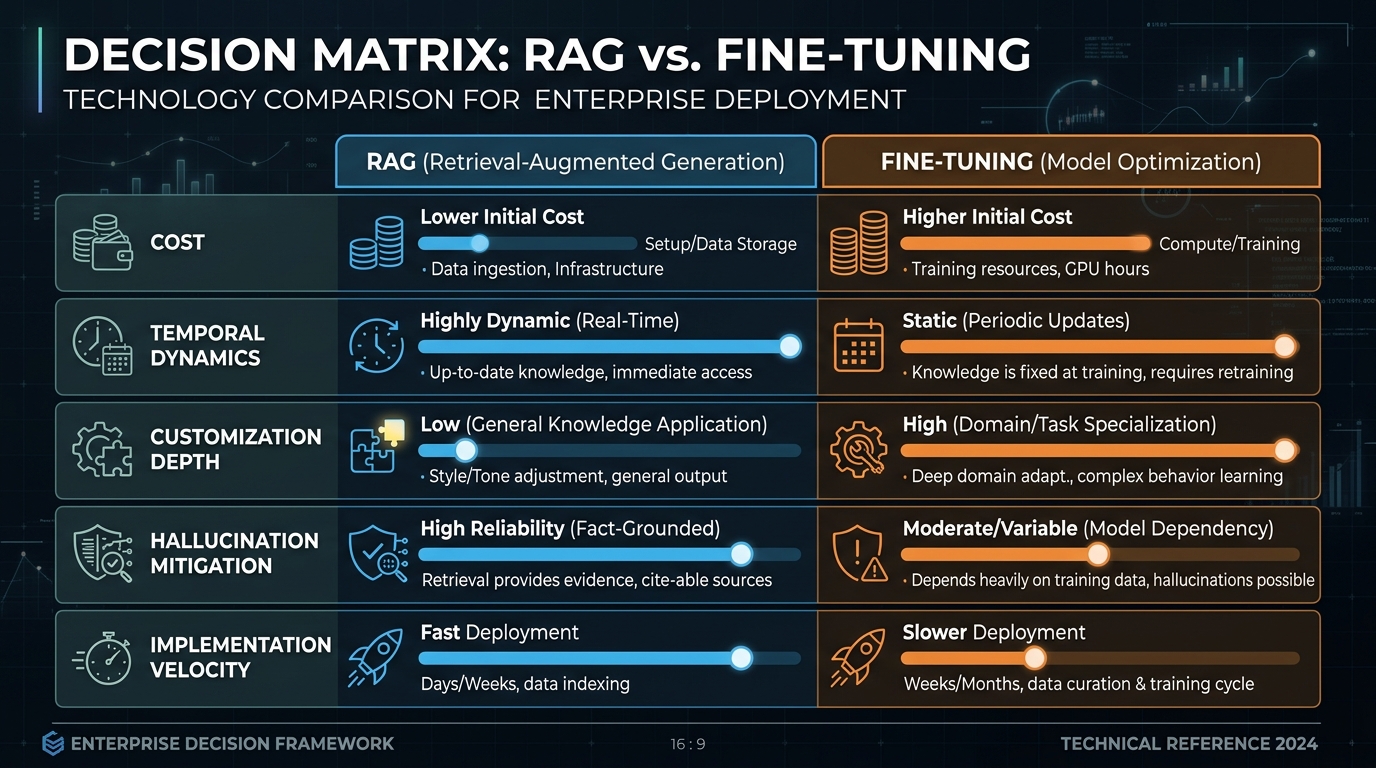
Selecting the right strategy requires balancing multiple trade-offs across cost, latency, data volatility, and specialized performance. The matrix below outlines how these two customization paths compare across critical enterprise dimensions.
| Evaluation Metric | Retrieval-Augmented Generation (RAG) | Fine-Tuning LLMs |
|---|---|---|
| Primary Purpose | Information access, grounding, and real-time data retrieval. | Pattern replication, style alignment, and domain specialization. |
| Knowledge Dynamism | Exceptional. Easily handles hourly or daily data changes. | Poor. Requires retraining loops to update internalized knowledge. |
| Upfront Cost | Low to Moderate (primarily vector database setup and pipeline design). | High (requires specialized compute, GPU time, and data preparation). |
| Inference Cost | Higher (longer prompt context windows increase token usage). | Lower (optimized prompts require fewer input tokens). |
| Hallucination Risk | Very Low (responses are strictly mapped to retrieved sources). | Moderate to High (the model relies on its internal parameters). |
| Data Requirements | Plain text documents, PDFs, or APIs (no specific formatting required). | Highly curated, labeled prompt-response pairs or structured corpora. |
The Enterprise AI Decision Framework: A Step-by-Step Evaluation
To determine which customization pathway aligns with your specific use case, enterprise engineering teams should systematically work through the following four-step decision framework.
Step 1: Analyze Data Volatility and Real-Time Requirements
The first and most critical question is: How often does your source data change?
If you are building an AI assistant for customer support that needs to quote current inventory levels, flight statuses, or updated service pricing, fine-tuning is practically impossible to maintain. Training a model is a static snapshot in time.
For dynamic, volatile, or rapidly updating datasets, RAG is the mandatory choice. RAG allows your model to access fresh data instantly by updating the underlying vector index, without requiring any model retraining.
Conversely, if your data is static (such as historical medical diagnostic codes, legal structures, or specialized programming language syntax), fine-tuning becomes a viable candidate.
Step 2: Define the Control Requirements (Behavior vs. Knowledge)
The second step is isolating whether your primary challenge is a knowledge deficit or a behavioral alignment deficit.
- If the goal is accuracy and provenance: If your system must cite its sources (e.g., legal discovery, medical compliance, financial auditing), RAG is essential. RAG provides a clear audit trail because every output can be traced back to a specific retrieved document in your database.
- If the goal is stylistic or structural fidelity: If your system must output complex JSON payloads that adhere to strict database schemas, write code in a proprietary internal framework, or adopt a highly specific brand voice across thousands of customer interactions, Fine-Tuning is superior. While you can attempt to guide behavior via long system prompts in RAG, models often suffer from "attention drift" in long contexts. Fine-tuning bakes these constraints directly into the model's architecture.
Step 3: Evaluate Resource and Budget Constraints
Developing enterprise AI systems requires a clear understanding of total cost of ownership (TCO).
- RAG Capital Expenditures (CapEx) vs. Operating Expenditures (OpEx): RAG has very low setup costs (CapEx). You can deploy a robust production-ready RAG pipeline in weeks. However, because you pass large blocks of retrieved text with every prompt, your ongoing API token costs (OpEx) will be higher.
- Fine-Tuning CapEx vs. OpEx: Fine-tuning has high upfront costs. You need clean, labeled training data, machine learning engineers to manage the training run, and dedicated GPU clusters. However, once the model is trained, your ongoing inference costs are much lower because you do not need to pack the context window with massive retrieval blocks. Your prompt lengths remain short and computationally efficient.
Step 4: Map Out Security, Privacy, and Access Controls
Enterprise data is rarely open to everyone. A major vulnerability of simple foundation model usage is the lack of granular permission layers.
If you fine-tune a model on sensitive executive payroll data or intellectual property, that knowledge is permanently baked into the model's weights. There is no way to selectively block an employee with lower clearance from prompting the model to reveal that information.
Implementing RAG allows you to inherit your company's existing data security posture. You can apply document-level access control filters directly to your vector retrieval pipeline, ensuring the model only references files the specific user is authorized to see.
Hybrid Architectures: The Best of Both Worlds
In complex enterprise deployments, customization is rarely a binary choice. The most advanced systems leverage a hybrid architecture that combines the behavioral precision of fine-tuning with the real-time knowledge retrieval of RAG.
[User Query]
     │
     ▼
┌────────────────────────────────────────┐
│  Orchestration / Security Gateway      │ (User permissions checked)
└────────────────────────────────────────┘
     │
     ├────────────────────────┐
     ▼                        ▼
┌──────────────────┐    ┌──────────────────┐
│ Vector Database  │    │ Fine-Tuned LLM   │ (Optimized for tone, domain
│ (Real-time RAG)  │    │ (Base Engine)    │  jargon, and JSON output)
└──────────────────┘    └──────────────────┘
     │                        │
     │ (Retrieved Context)    │
     └─────────────┬──────────┘
                   ▼
┌────────────────────────────────────────┐
│   Grounded, High-Fidelity Output       │
└────────────────────────────────────────┘
Real-World Example: An Enterprise Financial Analyst Assistant
Consider a top-tier investment bank building an AI platform to write comprehensive investment memos:
- The Fine-Tuning Layer: The bank fine-tunes an open-weights model (like LLaMA-3 or Mistral) on thousands of historical, high-scoring internal investment memos. This teaches the model the exact tone, analytical structure, risk compliance language, and formatting expected by the board.
- The RAG Layer: The bank overlays a secure RAG architecture onto this fine-tuned model. When an analyst asks for an update on a specific stock, the RAG system pulls the latest earnings transcripts, SEC filings, and market data from the morning's news feeds.
By combining both, the system produces a perfectly formatted, compliant investment memo (thanks to fine-tuning) that contains accurate, citation-backed, real-time financial figures (thanks to RAG).
Practical Execution: How to Get Started
To implement this decision framework successfully, follow this tactical roadmap:
- Start with RAG as your baseline: Unless your use case requires a highly specialized output structure or proprietary programming code, build a prototype using RAG first. It allows you to rapidly validate the business value of the use case with minimal upfront investment.
- Audit your data quality early: Both RAG and Fine-Tuning will fail if your internal data is chaotic, duplicate, or poorly structured. Invest in clean data pipelines, reliable metadata tagging, and robust document deduplication protocols.
- Isolate your latency requirements: If your application requires sub-second response times, large RAG contexts might introduce unacceptable lag. In these scenarios, fine-tuning a smaller, highly specialized local model can dramatically reduce latency while preserving output quality.
Related Reading
To learn more about implementing secure, highly integrated enterprise AI systems, explore our deep-dive guides:
Enjoyed this article? Join the Growency newsletter
Practical AI tips for service businesses, straight to your inbox. No spam, unsubscribe anytime.