September 6, 2026
Scaling Agentic Tool Access: Architecting Stateless MCP Gateways for Production
Scaling Agentic Tool Access: Architecting Stateless MCP Gateways for Production The artificial intelligence landscape is undergoing a fundamental shift. We a
Scaling Agentic Tool Access: Architecting Stateless MCP Gateways for Production
The artificial intelligence landscape is undergoing a fundamental shift. We are moving rapidly from isolated Large Language Models (LLMs) that merely chat, to autonomous agentic systems that act. To act, these agents need tools: databases, internal APIs, file systems, and third-party SaaS integrations.
However, as organizations move agents from proof-of-concept to enterprise-grade production, they hit a critical scaling wall. Managing direct, point-to-point connections between dozens of LLM agents and hundreds of microservices creates a chaotic, insecure, and fragile environment.
This is where the Model Context Protocol (MCP) comes in. To successfully scale agentic operations, modern organizations must design a stateless MCP gateway. This guide details the architectural blueprints, execution frameworks, and security paradigms required to build a highly scalable, stateless tool-access layer for production AI agents.
The Evolution to Protocol-Driven Tool Access
Historically, giving an LLM access to a tool meant writing custom glue code. Developers defined a JSON schema for a specific API, passed it to the model's function-calling endpoint, parsed the model's response, manually executed the function on a server, and returned the output to the model.
This approach fails at enterprise scale. When multiple teams build distinct agents using different frameworks (such as LangChain, AutoGen, or LlamaIndex), tool definitions become fragmented. Redundant APIs are developed, security policies are applied inconsistently, and rotating access credentials becomes a operational nightmare.
The Model Context Protocol, open-sourced to establish an open standard for how AI models connect to data and tools, solves this fragmentation. MCP formalizes the communication between client-facing agents and tool-providing servers.
But a protocol alone does not solve runtime scaling. In a production environment, you cannot allow every agent instance to spin up its own persistent, stateful connection to every backend database or legacy system. You need an intermediary architectural layer: a stateless MCP gateway.
Why Stateless? The Architectural Paradigm for Enterprise Scale
In a traditional stateful setup, an agent maintains an open, long-lived connection (like SSE or WebSockets) directly to a tool-hosting server. This approach introduces severe limitations:
- Resource Exhaustion: Stateful connections consume persistent memory and port allocations on both the agent host and the tool server, limiting concurrent agent capacity.
- Failure Vulnerability: If a tool-hosting node crashes, active agent sessions drop, losing execution state and forcing complex retry logic.
- Operational Friction: Scaling out tool servers requires complex session synchronization and sticky routing at the load balancer level.
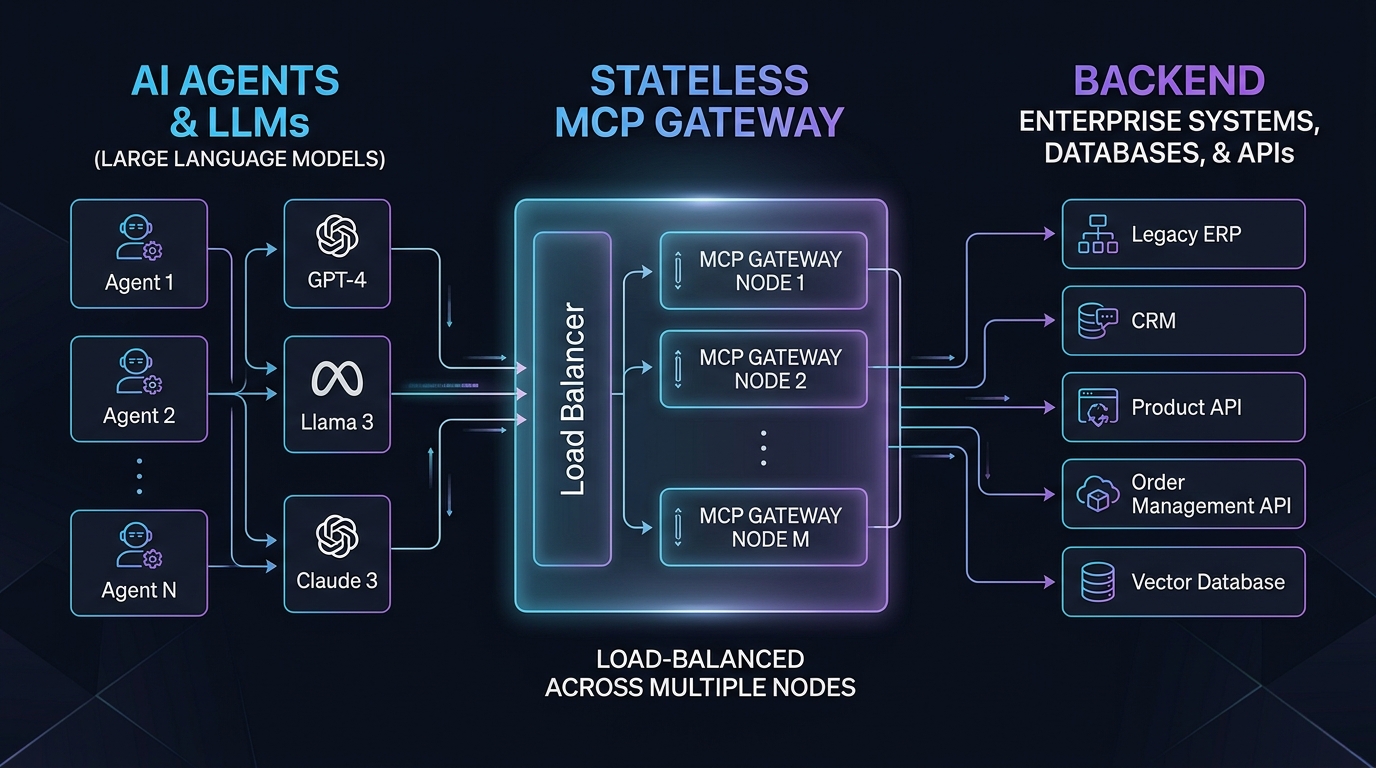
By decoupling the agent client from the tool server through a stateless MCP gateway, you resolve these bottlenecks. The gateway processes each tool discovery request, schema validation, and execution call as an independent transaction.
| Feature | Stateful Tool Orchestration | Stateless MCP Gateway |
|---|---|---|
| Scaling Mechanism | Vertical scaling, sticky sessions, high memory overhead | Horizontal auto-scaling, standard load balancing |
| Resiliency | Single point of connection failure; dropped sessions | Instant failover to redundant gateway instances |
| Security Boundary | Hard to enforce centrally; credentials scattered | Centralized OAuth, token translation, and auditing |
| Connection Overhead | Constant keep-alives and idle connection consumption | Ephemeral HTTP/gRPC requests, backend connection pooling |
| Resource Efficiency | Low; bound by active session limits | High; dynamically scales with request volume |
Blueprint of a Production-Grade Stateless MCP Gateway
An enterprise-ready stateless MCP gateway acts as a high-performance proxy. It sits between your agent runtimes (like LLM orchestrators) and your actual tool servers (the microservices that read databases, trigger webhooks, or query search indices).
The architecture consists of four primary, decoupled components:
1. The Client-Facing API Layer
This ingress layer exposes standard MCP endpoints via HTTP/2 or gRPC. It handles initial request validation, TLS termination, and rate-limiting. Because the gateway is stateless, this ingress can be placed behind standard global load balancers (such as AWS ALB or Cloudflare).
2. The Dynamic Schema Registry
Agents must know what tools are available. Instead of querying every individual tool server in real time, the gateway maintains an in-memory, distributed cache of tool schemas (utilizing Redis or Memcached). Tool servers register their JSON schemas with the gateway upon deployment. The gateway then serves unified schema catalogs to the agents instantly.
3. The Security and Policy Enforcement Engine
This engine is the gatekeeper. When an agent requests a tool execution, the security engine validates the agent's identity, evaluates Role-Based Access Control (RBAC) rules, sanitizes input payloads to prevent prompt-injection style attacks, and injects backend credentials securely.
4. The Routing and Execution Handler
Once authorized, the execution handler translates the incoming MCP request into the appropriate backend protocol (such as a gRPC call, a REST request, or a direct database query). It utilizes connection pooling to interact with downstream systems, eliminating the latency of establishing new TCP handshakes for every single tool invocation.
Key Insight: Designing the gateway to be completely stateless means that no database transactions, agent history, or execution variables are stored on the gateway disk. If a gateway node dies mid-execution, the load balancer routes the retried request to a sister node without any data loss or operational friction.
Step-by-Step Execution Framework for Building the Gateway
Deploying a production-grade gateway requires a methodical approach to development and deployment. Follow this four-step framework to architect your system.
Step 1: Establish a Central Tool Schema Registry
To keep your gateway stateless, you must decouple tool definition from tool execution. Establish a unified registration pipeline.
{
  "mcp_version": "1.0.0",
  "tool_name": "fetch_customer_billing",
  "description": "Retrieves active subscription status and payment history for a customer ID.",
  "input_schema": {
    "type": "object",
    "properties": {
      "customer_id": {
        "type": "string",
        "pattern": "^CUST-[0-9]{6}$"
      }
    },
    "required": ["customer_id"]
  }
}
Implement an automated CI/CD step where backend teams deploy microservices alongside an MCP manifest. The microservice registers this manifest with the gateway's registry during its startup routine.
Step 2: Implement Stateless JWT-Based Authorization
Do not manage user sessions on the gateway. Instead, utilize short-lived JSON Web Tokens (JWTs) issued by your central Identity Provider (IdP).
When an agent calls a tool, it must pass a JWT containing the user's identity context and authorized scopes. The gateway validates the cryptographic signature of the JWT using a cached public key. This approach ensures the gateway can authorize requests instantly without making blocking database calls to verify user sessions.
Step 3: Design the Routing Layer with Connection Pooling
To bridge the gap between stateless incoming requests and potentially stateful backend databases, implement robust connection pooling in the routing layer.
Use highly concurrent runtimes like Go, Rust, or Node.js (with keeping-alive enabled) to build the gateway core. Maintain pre-warmed connection pools to your primary downstream tool servers. This mitigates the latency overhead of establishing secure handshakes on every agent action.
Step 4: Establish Real-Time Observability and Auditing
Agentic tool use presents unique security risks. You must log every tool execution with strict metadata linking the action back to the triggering LLM session and the human supervisor.
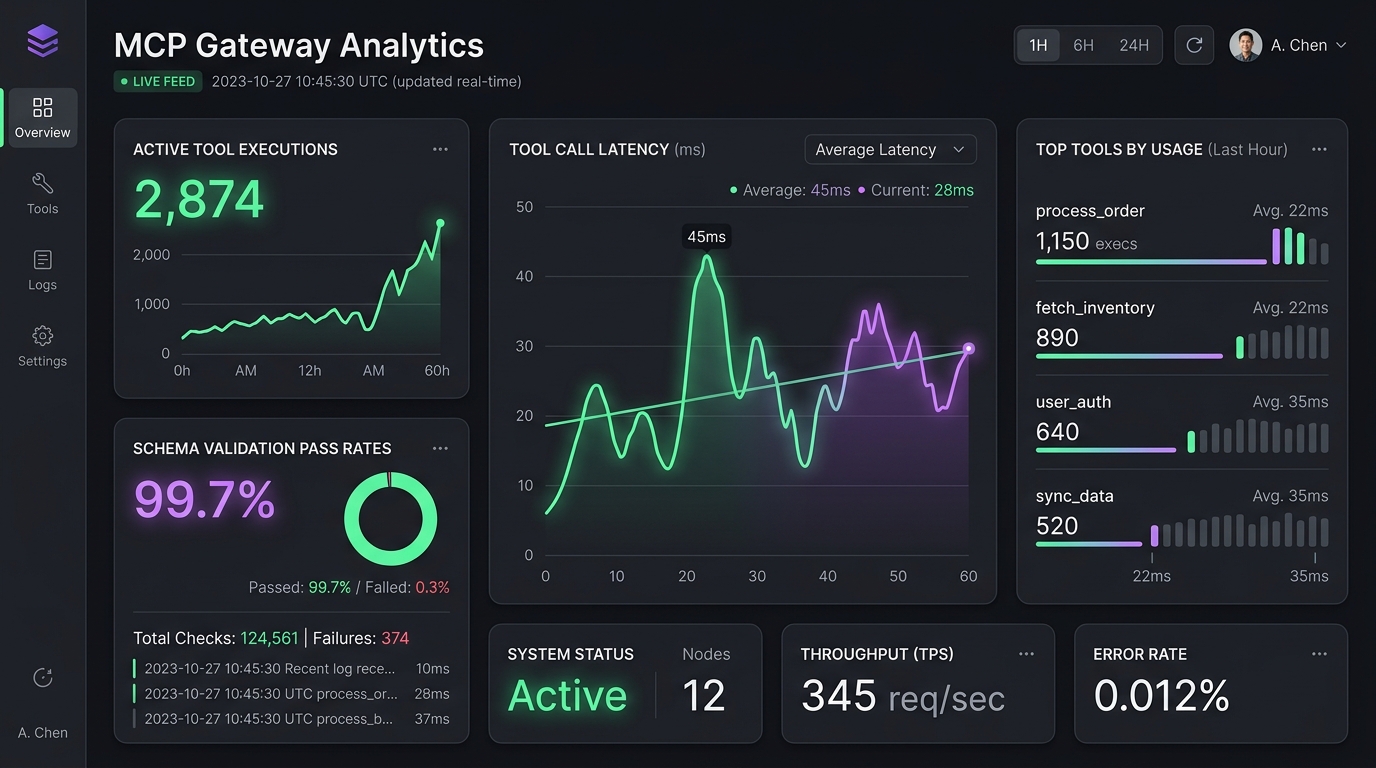
Your gateway should export structured telemetry (logs, metrics, and traces) to central platforms like OpenTelemetry, Datadog, or Prometheus. Track key metrics such as:
- Tool execution latency (broken down by internal processing vs. downstream execution)
- Authorization failure rates (critical for spotting rogue agent behavior)
- Tool schema validation errors (essential for debugging agent hallucination)
Mitigating Production Risks: Security, Latency, and Sprawl
When scaling agentic tool access, you will encounter real-world engineering challenges. Here is how to address the three most prominent risks.
1. Prompt Injection and Tool Payload Sanitization
LLMs can be manipulated via prompt injection to generate malicious inputs to tools. For instance, if an agent uses a tool to search a database, a compromised agent could pass a SQL injection payload disguised as a search query.
Mitigation: The gateway must enforce strict input sanitization. Use JSON Schema validation on the gateway to reject payloads that do not strictly conform to the registered tool schema. Never allow agents to pass raw SQL, command-line arguments, or unvalidated URLs through the gateway.
2. Network Latency Accumulation
Adding a gateway layer introduces an extra network hop. If your LLM has to make multiple, sequential tool calls (known as multi-step chain-of-thought), gateway latency can degrade the user experience.
Mitigation: Deploy your stateless gateway in the same network region as your primary LLM inference endpoints (for example, AWS us-east-1 or Google Cloud us-central1). Enable HTTP/2 multiplexing on the gateway to allow concurrent tool calls over a single connection, and cache static tool outputs where appropriate.
3. Tool Sprawl and Redundancy
As different departments build autonomous workflows, you will quickly encounter "tool sprawl" - dozens of slightly different variations of the same tool, leading to security vulnerabilities and wasted computing resources.
Mitigation: Establish a central governance registry. Categorize tools by domain and deprecate redundant integrations. This ensures your engineering resources are focused on maintaining a highly secure, performant core set of enterprise capabilities.
Conclusion: Empowering the Autonomous Enterprise
Architecting a stateless MCP gateway is not merely a performance optimization - it is a foundational requirement for enterprise AI adoption. By decoupling agent intelligence from tool execution, you build an architecture that scales horizontally, enforces robust zero-trust security, and provides complete visibility into autonomous operations.
As you design your agentic ecosystem, prioritize standardization, stateless scaling, and strict security controls. By establishing a robust MCP gateway today, you set the stage for safe, reliable, and powerful autonomous automation tomorrow.
Related Reading
Enjoyed this article? Join the Growency newsletter
Practical AI tips for service businesses, straight to your inbox. No spam, unsubscribe anytime.