September 6, 2026
State Management in AI Swarms: A Git-Native Guide
Learn how the Git-Native Agent Protocol (GNAP) solves state management for agentic swarms. Discover how to orchestrate AI agents using Git as a database.
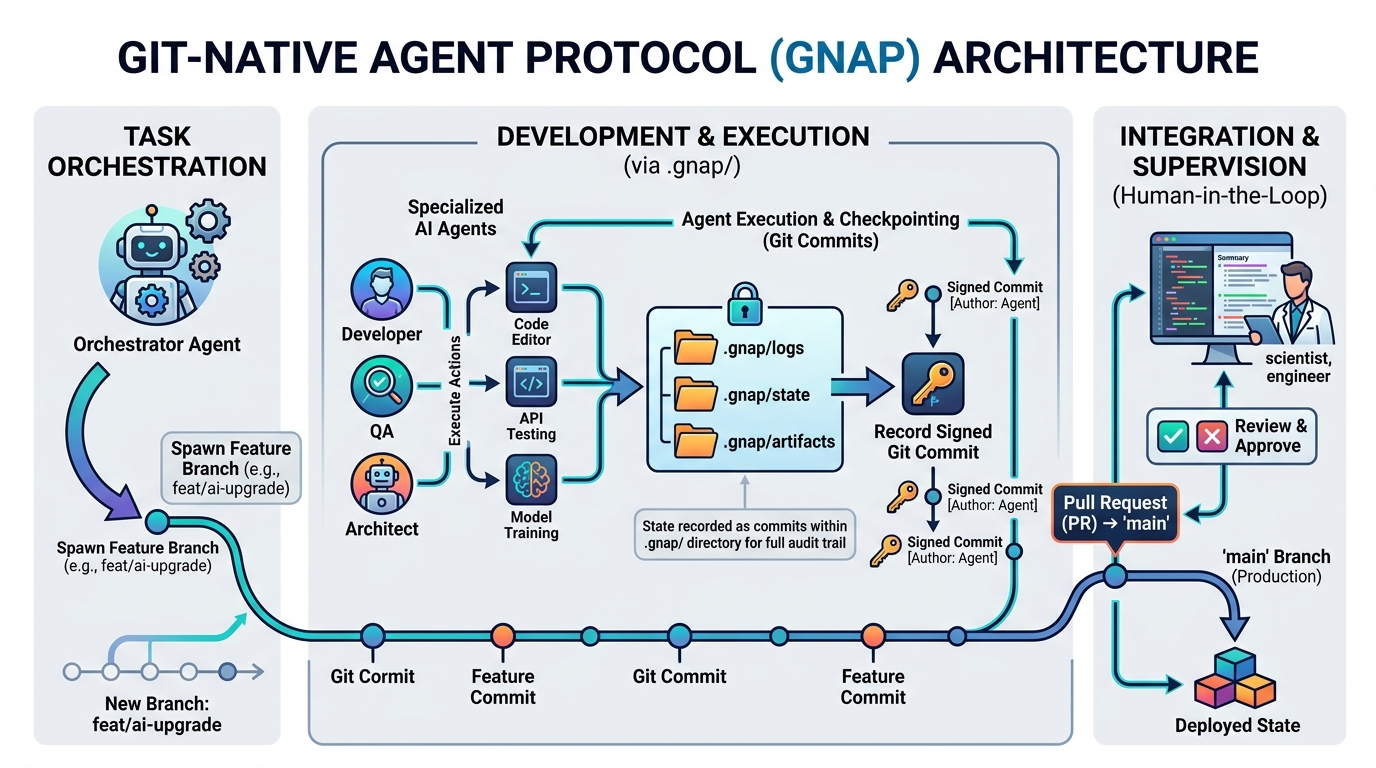
Git as the Database: Orchestrating Agentic Swarms with the Git-Native Agent Protocol (GNAP)
State management is the silent killer of multi-agent systems. When dozens of autonomous agents collaborate on complex tasks, keeping track of who did what, when, and with what context becomes a monumental challenge. Traditional databases like Redis or PostgreSQL excel at structured queries, but they struggle to capture the branch-and-merge nature of collaborative reasoning. They lack built-in version control, auditable change histories, and intuitive review gateways for human supervisors.
Enter the Git-Native Agent Protocol (GNAP). By treating Git as the primary database, you can orchestrate agentic swarms using the exact same workflows developers have perfected for decades. This guide explores how to build and scale decentralized AI workflows by turning repositories into deterministic, collaborative agent environments.
Why Git is the Perfect Database for Autonomous Agents
Let's address the core paradigm shift: using git as a database. For agents, a database is not just a place to store variables; it is a collaborative workspace.
Traditional databases write state destructively or append-only without native contextual history. If an agent goes off the rails on step 14, debugging requires parsing dry database logs or reconstructing state from vector memory.
In contrast, Git offers several unique advantages:
- Immutable History: Every single action, tool call, and decision can be recorded as a commit.
- Branch-Based Isolation: Agents can fork the workspace, execute speculative tasks, and discard them if they fail, all without polluting the main branch.
- Cryptographic Trust: Commits can be cryptographically signed by the agent's private key, ensuring absolute non-repudiation.
- Human-in-the-Loop Integration: Pull Requests act as a natural staging environment where humans can review, comment on, and approve agent actions.
Let's compare traditional databases with Git for agentic swarm orchestration.
| Orchestration Feature | Traditional Databases (Redis/Postgres) | Git-Native Database (GNAP) |
|---|---|---|
| State Rollbacks | Complex database migrations or snapshot restores | Simple git checkout or git revert |
| Work Isolation | Requires separate database schemas or rows | Lightweight feature branches |
| Auditability | Custom application logging required | Cryptographically signed commit histories |
| Human Review | Custom admin UI must be built | Standard Git platforms (GitHub, GitLab, Gitea) |
| Multi-Agent Handoffs | Message queues (RabbitMQ, Kafka) | Pull Requests and Git event hooks |
The Core Pillars of the Git-Native Agent Protocol (GNAP)
The Git-Native Agent Protocol (GNAP) is a structured specification that defines how agents write state, hand off tasks, and resolve conflicts inside a Git repository.
GNAP operates on three foundational pillars:
1. The Git-Native Workspace (.gnap/ directory): Every repository orchestrated by GNAP contains a hidden directory called .gnap/. This folder contains the state files, active task queues, and agent metadata. By saving these as JSON or YAML files, the agent's internal state is fully serialized directly within the project repository.
2. Branches as Sandbox Environments: When an orchestrator agent delegates a task to a specialized agent, it does not execute the code on the main branch. Instead, it spawns a new branch, such as agent/refactoring-wizard. This branch acts as an isolated sandbox. If the agent breaks the codebase, the damage is restricted to that branch.
3. Commits as Epochs: Each run loop of an agent is finalized by a Git commit. A commit message acts as the agent's written log of what it accomplished, while the diff shows the exact modifications to the workspace.
Implementing GNAP: A Step-by-Step Execution Framework
To implement GNAP in your agentic swarm orchestration, you must define a standardized state schema and toolset. Let's look at how an agent reads, executes, and commits its state.
First, define the agent state file inside .gnap/state.json:
{
  "agent_id": "code-analyzer-01",
  "current_task": "audit-security-vulnerabilities",
  "status": "in-progress",
  "memory": {
    "last_inspected_file": "src/auth.py",
    "detected_issues": 3
  },
  "epoch": 4,
  "timestamp": "2023-10-27T14:32:00Z"
}
Every time the agent performs an action, it runs a loop that updates this file and commits the change:
# The Agentic Run Loop Execution
git checkout -b agent/security-audit

# Agent executes Python analysis tool...
# Agent updates .gnap/state.json with findings

git add .gnap/state.json src/auth.py
git commit -m "feat(agent): resolve insecure session cookie in auth.py"
git push origin agent/security-audit
By executing tasks this way, the agent's history is written cleanly to the repository log.
Key Insight: Committing state directly to Git ensures that your AI agents remain entirely stateless at the runtime level. If an agent container crashes mid-execution, a new container can spin up, pull the repository, read
.gnap/state.json, and resume from the exact commit where the previous container stopped.
Managing Concurrency and Conflict Resolution
In a massive multi-agent system, multiple agents may try to write to the repository simultaneously. Under a traditional setup, this would lead to lock contention. Under GNAP, it leads to merge conflicts.
To handle conflict resolution within agentic swarm orchestration, GNAP utilizes three deterministic strategies:
- Deterministic Merging: If two agents modify non-overlapping files (such as different modules of an application), Git handles the merge automatically and seamlessly.
- Orchestrator Arbitrated Merging: If a conflict occurs on shared configuration files, an orchestrator agent is called to resolve the conflict. The orchestrator pulls the diffs from both branches, reviews the conflicting logic, writes a resolved file, and commits the resolution.
- Branch Rebasing: Agents are programmed to perform a
git pull - rebase origin mainbefore pushing. If the rebase fails due to structural conflicts, the agent pauses, reverts its active branch to the last known safe commit, and re-evaluates its execution path based on the updatedmainbranch state.
Enterprise Governance and Human-in-the-Loop Safety
Deploying autonomous agents in production requires rigorous safety guardrails. GNAP provides a native solution to this problem through the Pull Request mechanism.
Instead of building proprietary human-in-the-loop interfaces, you can leverage existing Git enterprise tools like GitHub or GitLab. When an agent finishes its task, it opens a Pull Request to the main branch.
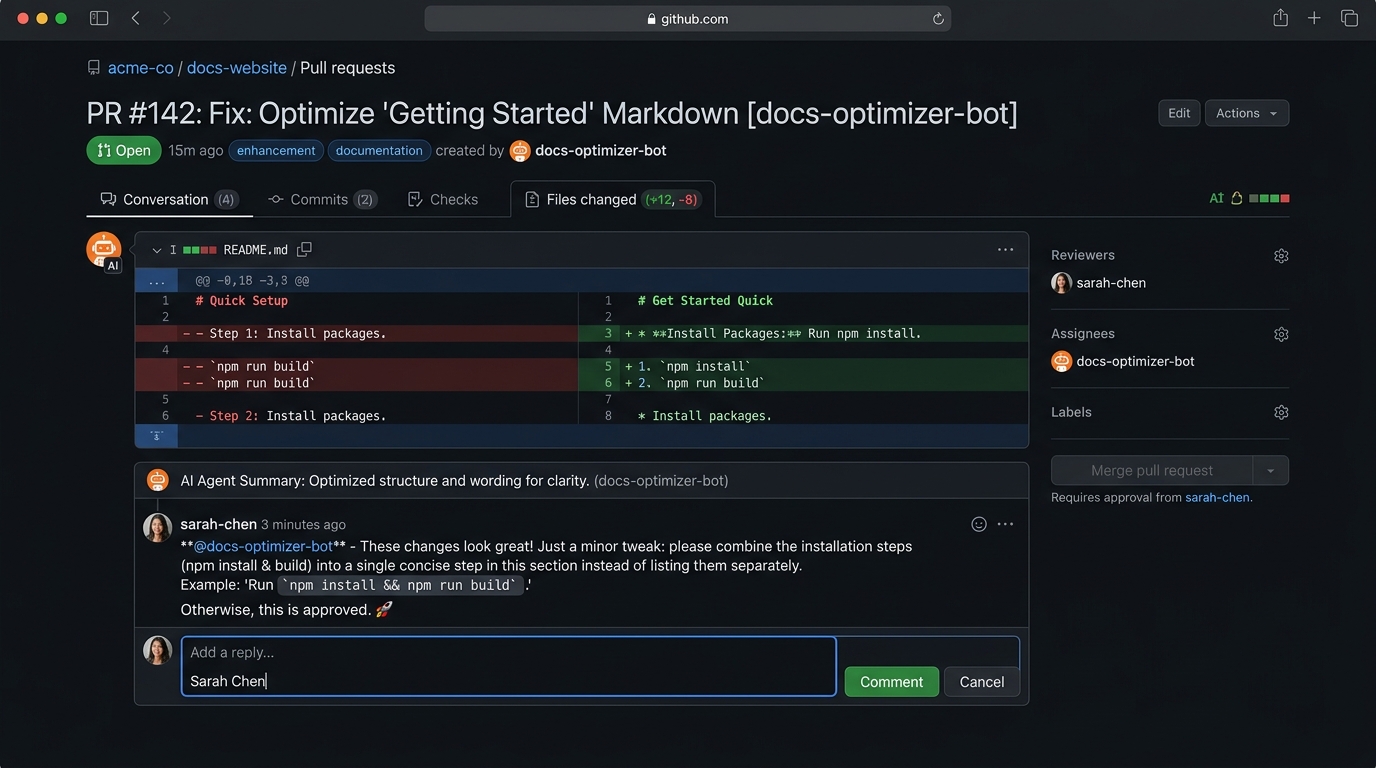
Human team members can review the diffs, read the commit messages generated by the agent, and run automated CI/CD pipelines to verify code safety.
If the agent's work is satisfactory, the human merges the PR. If changes are requested, the agent reads the PR review comments, commits the requested fixes to the same branch, and pushes the updates. This creates a highly collaborative environment where humans and agents interact using standardized, auditable software engineering patterns.
Related Reading
To learn more about optimizing and securing your agentic architectures, explore our in-depth guides:
Enjoyed this article? Join the Growency newsletter
Practical AI tips for service businesses, straight to your inbox. No spam, unsubscribe anytime.